
Application / Industrial Process Safety
Industrial Process Safety Gas Detection & Sensor Selection
Detection points, ranges and sensing principles for toxic gases in petrochemical, chemical, metallurgy and mining plants, with the compliance thresholds that govern confined-space entry.
- 19.5–23.5% vol Acceptable O₂ band on entry
- 10% LEL Combustible entry limit
- ≤ 35 ppm CO entry limit (OSHA 1910.146)
- ≤ 10 ppm H₂S entry limit
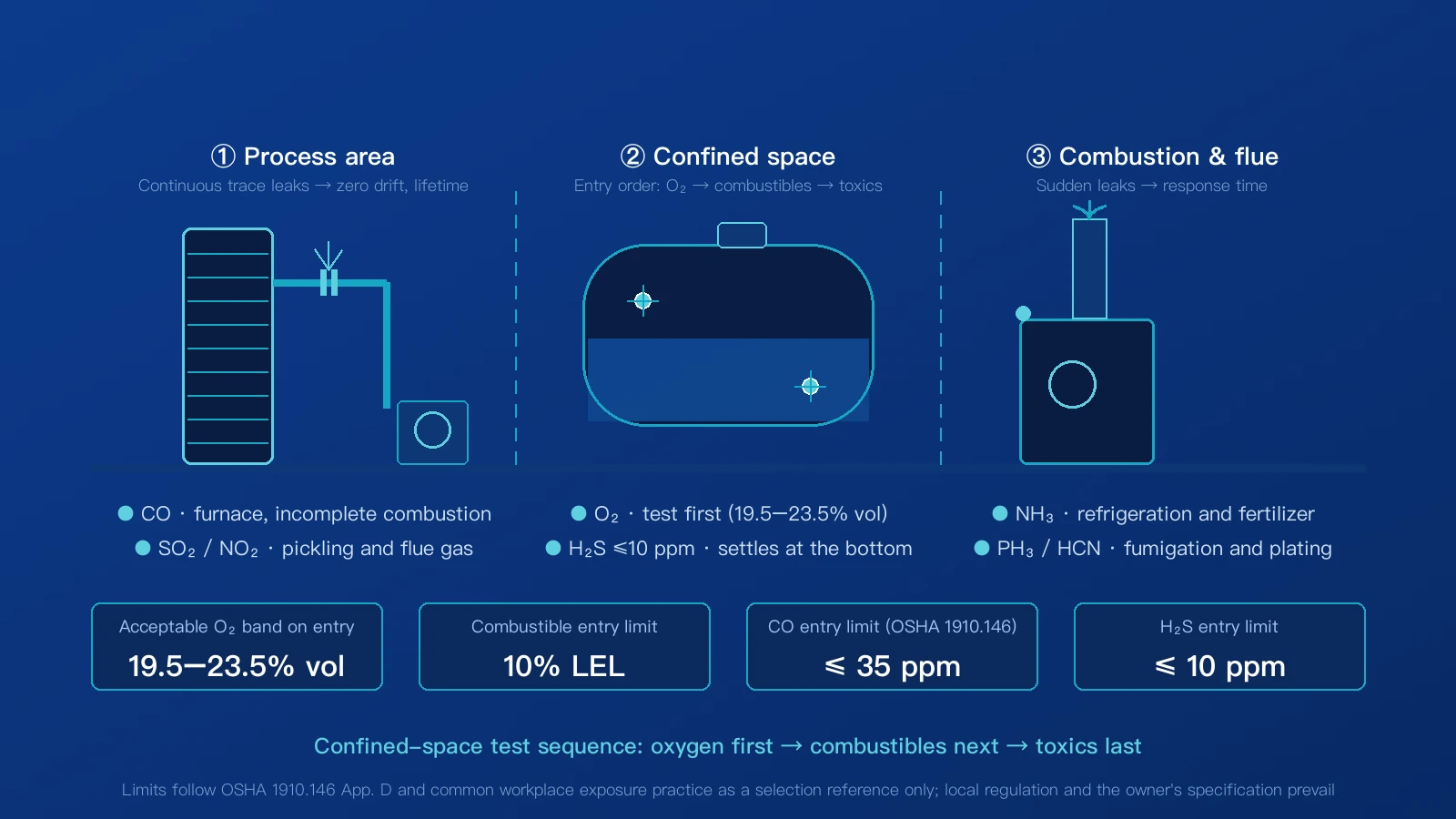
Three Kinds of Leak, Three Different Criteria
Continuous trace leaks in process areas are about long-term zero stability: the detector runs 24/7 and is calibrated on a cycle, so repeatability and lifetime are what matter. Sudden leaks at flanges, valves and pump seals are about response time — the sensor has to climb within tens of seconds. Confined-space work is about the entry criterion, not the alarm setpoint: whether the pre-entry reading passes.
Why Smart Digital Modules Beat Bare Cells on Site
A bare cell outputs a nanoamp-to-microamp current, which means building your own amplifier, temperature compensation, ADC stage and calibration rig. Most plants have neither the instruments nor the staff for that, so a module is the practical answer.
- Factory-calibrated with standard gas; the data lives in module flash, so power-up gives you a concentration
- Onboard temperature and humidity sensing — no extra probe for outdoor or high-swing sites
- UART / I²C digital output, wired straight into a PLC, DTU or your own board
- -40 °C to +55 °C operating range, covering both winter sites and summer shelters
Lifetime and Calibration Cycle Drive Total Cost of Ownership
Electrochemical toxic-gas sensors typically last 2–3 years, with CO and H₂S at the long end and highly reactive gases such as PH₃ and HCN at the short end. A 3–6 month calibration cycle is normal, tightening to 3 months in corrosive service. Ask whether the cell can be replaced on its own — in a modular build you swap the consumable and keep the board, which matters far more than the unit price.
Detection Points and Ranges for Process Plants
The eight detection points we are asked about most. Pick a range so the alarm setpoint lands in the 10%–30% band of full scale — otherwise resolution runs out exactly where you need it.
| Gas | Typical Range | Recommended Principle | Duty Notes |
|---|---|---|---|
| Carbon monoxide (CO) | 0–100 / 0–1000 ppm | Electrochemical (3-electrode amperometric) | Entry limit ≤35 ppm; furnaces, gas boilers and incomplete combustion are the main sources. |
| Hydrogen sulphide (H₂S) | 0–10 / 0–100 ppm | Electrochemical | Entry limit ≤10 ppm. High concentrations paralyse the sense of smell — never judge by odour. |
| Oxygen (O₂) | 0–25% vol | Electrochemical (galvanic) | Acceptable band 19.5–23.5% vol; mandatory after nitrogen purging or inerting. |
| Ammonia (NH₃) | 0–100 / 0–1000 ppm | Electrochemical | Refrigeration plant and fertilizer units; size the range for the worst-case release, not normal operation. |
| Phosphine (PH₃) | 0–20 ppm | Electrochemical (low range, high resolution) | Fumigation and semiconductor processes; you need sub-ppm visibility, so choose 20 ppm full scale rather than 1000 ppm. |
| Hydrogen cyanide (HCN) | 0–50 ppm | Electrochemical smart module | Electroplating and acrylonitrile units; acutely toxic with no reliable warning odour — use online modular monitoring. |
| Sulphur dioxide (SO₂) / nitrogen dioxide (NO₂) | 0–20 / 0–100 ppm | Electrochemical | Pickling lines, metallurgical flue gas and boilers; NO₂ is the usual reference species for NOx. |
| VOC / all-gas equivalent | 0–200 ppm | Solid-polymer electrochemical | Solvent, coating and cleaning shops — total-VOC trending and over-limit alarms. Species identification still needs a PID. |
Thresholds follow OSHA 1910.146 appendix D and common workplace exposure practice, for selection reference only; final alarm values must follow local regulation and the owner's specification.
Models Commonly Used On Site
The models ordered most often for industrial safety duty — factory-calibrated smart digital and multi-range electrochemical types.
10 gas categories covered
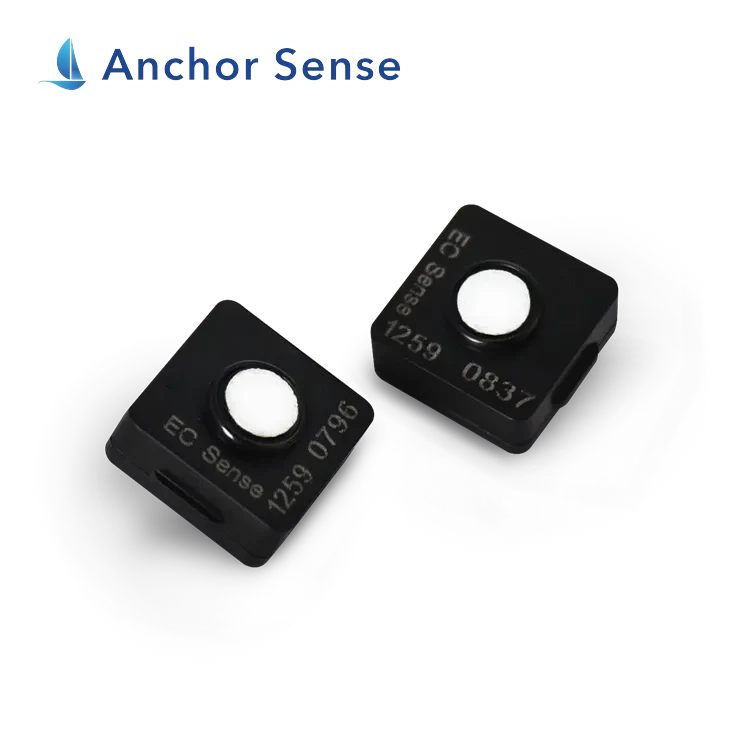
ES1-H2S-10 Hydrogen Sulfide Gas Sensor
Amperometric, 3-electrode
ES1 package, 0 – 10 ppm range, Hydrogen Sulfide detection
View Details → ES1-CO-100 Carbon Monoxide Gas Sensor
Amperometric, 3-electrode
ES1 package, 0 – 100 ppm range, Carbon Monoxide detection
View Details →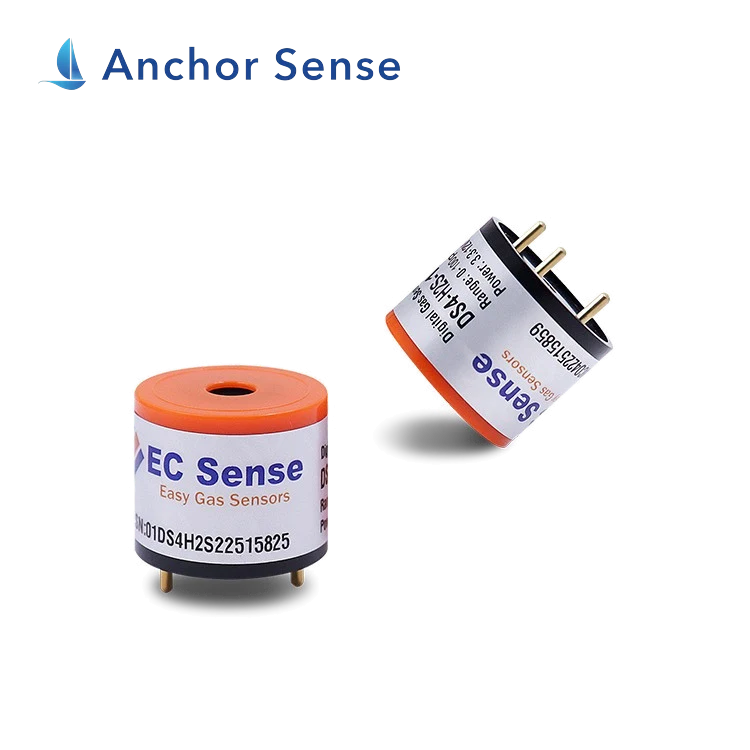
DS4-PH3-20 Smart Phosphine Gas Sensor
Printed Solid-Polymer Electrochemical (smart digital output)
EC Sense DS4 smart Phosphine sensor, 0 – 20 ppm range, 0.1 ppm resolution, UART digital output, factory-calibrated
View Details →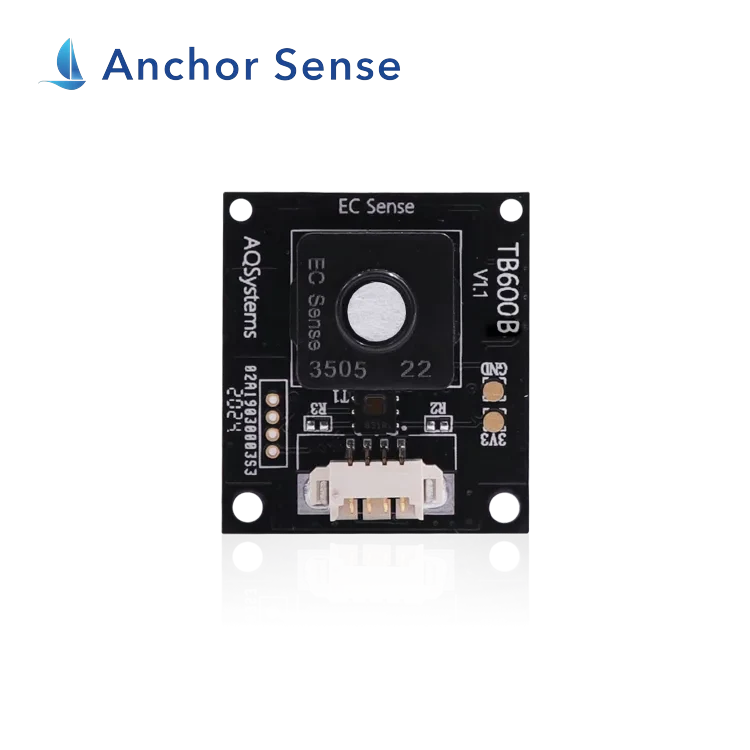
TB600B-HCN-50 Hydrogen Cyanide Detection Module
Solid-Polymer Electrochemical (smart digital module)
0 – 50 ppm Hydrogen Cyanide smart digital detection module with UART / I²C output, built-in temp/RH sensing and factory calibration
View Details →Related Series
Frequently Asked Questions
How often should an electrochemical sensor be calibrated?
Six months in normal service, three months where corrosion or high humidity is present. For highly reactive gases such as PH₃ and HCN we suggest going straight to a 3-month cycle and logging every calibration.
Why must oxygen be tested first in a confined space?
Catalytic combustible sensors need oxygen to work; in a depleted atmosphere they read low or not at all. Testing oxygen first both answers the entry question and makes the combustible reading trustworthy.
Can one probe measure several gases at once?
A 4-gas unit (O₂ / combustible / CO / H₂S) is right for entry screening and walk-around checks. For fixed online monitoring, separate probes per gas avoid cross-interference and keep one short-lived cell from dictating the calibration cycle of the whole unit.
Do you supply complete detectors?
We supply sensors, bare cells and digital modules, and handle selection matching and volume supply for detector makers and integrators. The finished instrument is built on your line — we do not bid for tenders.
Send Us Your Duty Conditions, Get a Selection Within 24 Hours
Tell us the gas, alarm setpoint, required range, ambient temperature and humidity, output interface (UART / I²C / analogue) and annual volume.
Contact us