
Application / Combustible Gas & Explosion Safety
Combustible Gas Detection & Flammable Leak Sensor Selection
Find the leak early: sensing principles and detection points for methane, propane, hydrogen and refrigerants, whose LELs and background interference differ — principle beats point count.
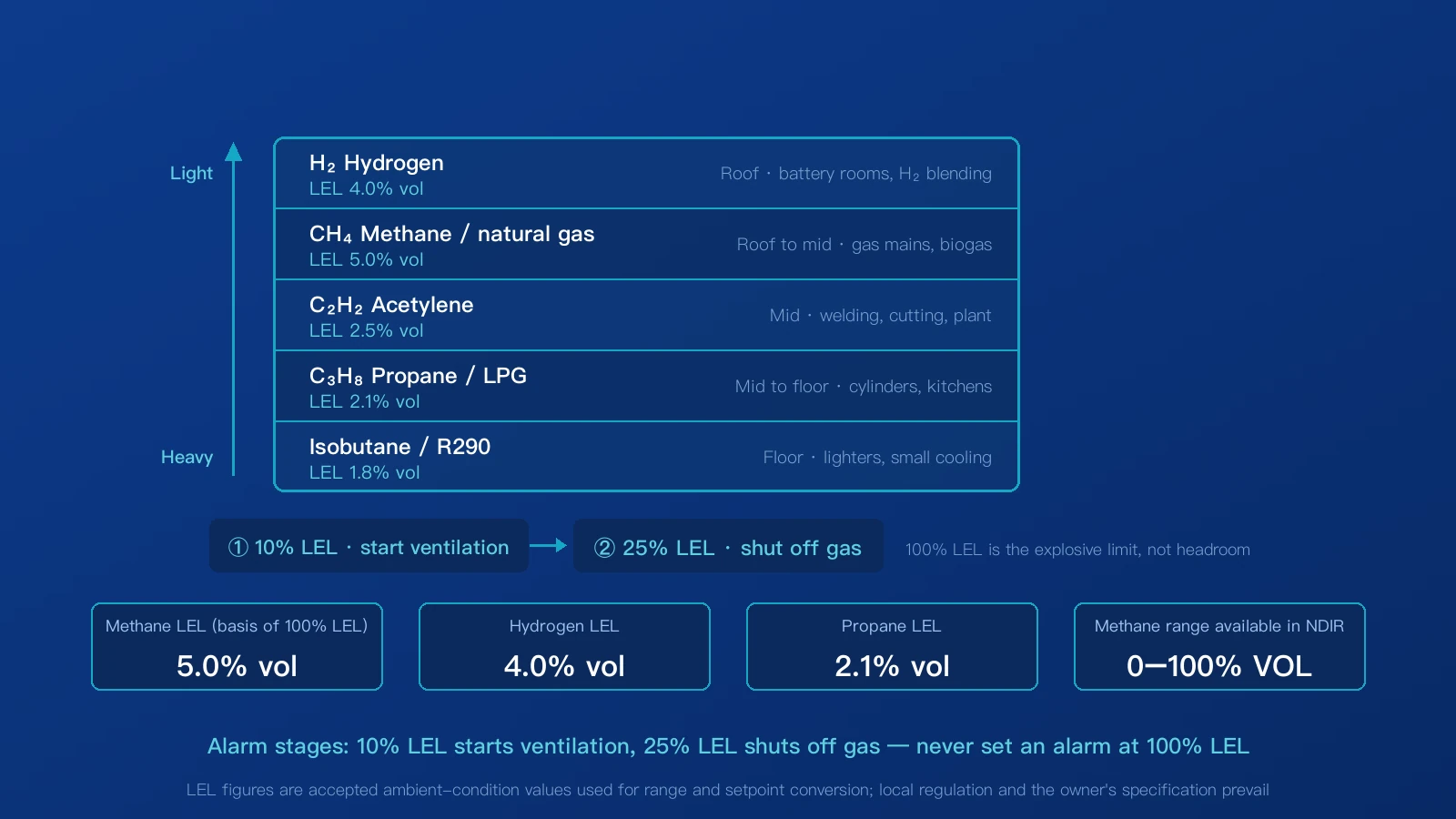
- 5.0% vol Methane LEL (basis of 100% LEL)
- 4.0% vol Hydrogen LEL
- 2.1% vol Propane LEL
- 0–100% VOL Methane range available in NDIR
%LEL and %VOL Are Two Different Jobs
100% LEL for methane is 5% vol, while 100% VOL is 100% vol — a factor of twenty apart. An LEL-range sensor saturates on high-concentration process gas, while a VOL-range device lacks the resolution to see a small leak. Most projects need the LEL range; reserve VOL for blending, biogas upgrading and other cases where you are measuring concentration rather than hunting leaks.
Catalytic, Infrared or Optical: Don't Bet a Bead on an Inerted Atmosphere
Catalytic beads are cheap, fast and respond to almost any combustible gas, which is why they dominate gas alarms. They carry two hard limitations, though: they need oxygen, and they are poisonable. Silicone vapour from sealants, release agents and silicone oil forms an irreversible inert layer on the bead, and sulphur or halogen compounds cause equally permanent sensitivity loss.
Setting the Alarm Values
A common arrangement is a first-stage alarm at 10% LEL and a second stage at 25% LEL, with stage one starting ventilation and stage two shutting off gas or power. The final figures must follow local regulation and the owner's specification — permissible values for the same duty vary widely between countries, and copying a neighbouring standard is a familiar source of incidents.
Hydrogen Is the Exception Infrared Can't See
H₂ is a symmetric diatomic molecule with no infrared absorption band, so neither NDIR nor infrared optics respond to it at all. Hydrogen has to be measured catalytically, thermally or electrochemically — electrochemical for ppm-level early warning, catalytic or thermal conductivity for %LEL alarms.
Combustible Detection Points and Ranges
Natural gas, LPG and refrigerant often coexist on one site. One detector per gas keeps you clear of conversion errors and cross-interference.
| Gas | Typical Range | Recommended Principle | Duty Notes |
|---|---|---|---|
| Methane (CH₄) | 0–100% LEL / 0–100% VOL | NDIR infrared | Main constituent of natural gas, LEL 5.0% vol. NDIR is oxygen-independent and poison-resistant, typically good for 5 years or more. |
| Propane (C₃H₈) / LPG | 0–100% LFL | Low-power infrared optical | Cylinder gas and outdoor burners, LEL 2.1% vol. Heavier than air — put detection points low. |
| Hydrogen (H₂) | 0–1000 ppm / 0–4% vol | Electrochemical / catalytic / thermal conductivity | LEL 4.0% vol. No infrared absorption band, so infrared is useless here; the lightest gas, so sensing points go high. |
| Acetylene (C₂H₂) | 0–100 / 0–500 ppm | Electrochemical | Welding, cutting and chemical plant, LEL 2.5% vol; a ppm range is more useful here because volumetric concentration already tells the story. |
| Isobutane | 0–100% LFL | NDIR / optical | Lighters and small refrigeration units, LEL 1.8% vol — a low limit leaves little alarm margin. |
| Ethanol | 0–100% LFL | Low-power infrared optical | Distilleries, disinfection and pharmaceutical shops, LEL 3.3% vol; guard against condensation in humid areas. |
| Flammable refrigerants R290 / R32 / R600A | 0–100% LFL | NDIR infrared | Plant rooms and new equipment using A3 / A2L refrigerants; leak alarms are required by regulation. |
| Carbon monoxide (CO), co-generated | 0–1000 ppm | Electrochemical | A by-product of incomplete combustion; co-locating it with combustible points lets both share a power and acquisition channel. |
LEL figures are the accepted values at ambient temperature and pressure, used for range and setpoint conversion; projects must follow local regulation and the owner's specification.
Models for Combustible Duty
Covering NDIR infrared, low-power optical and electrochemical routes — converge in two steps: is the atmosphere inerted, and does the node run on batteries?
9 gas categories covered
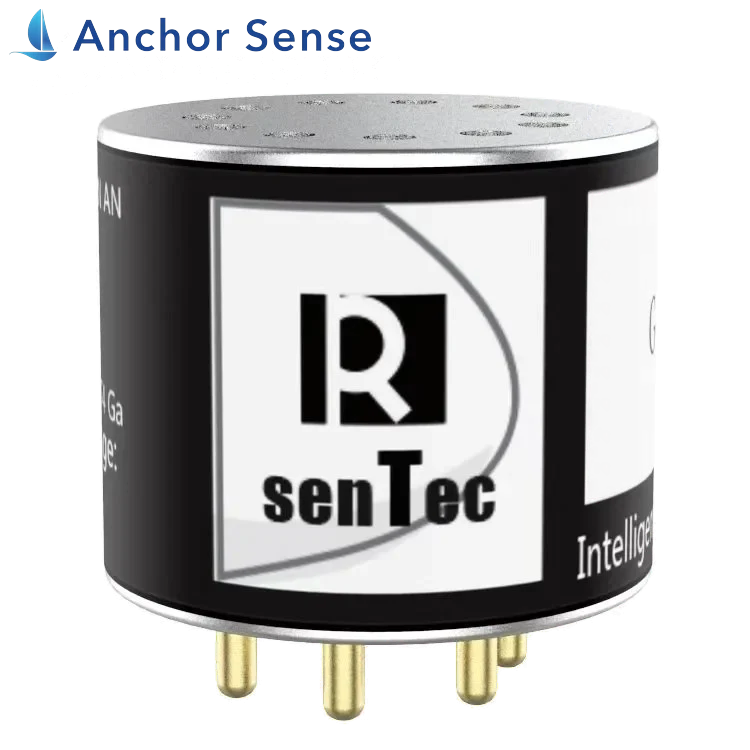
G4111 Methane NDIR Infrared Gas Sensor
Non-Dispersive Infrared (NDIR, dual-wavelength optical path)
Shanghai Yixin G4111, 0 – 100% LEL range, dual-wavelength NDIR detection
View Details →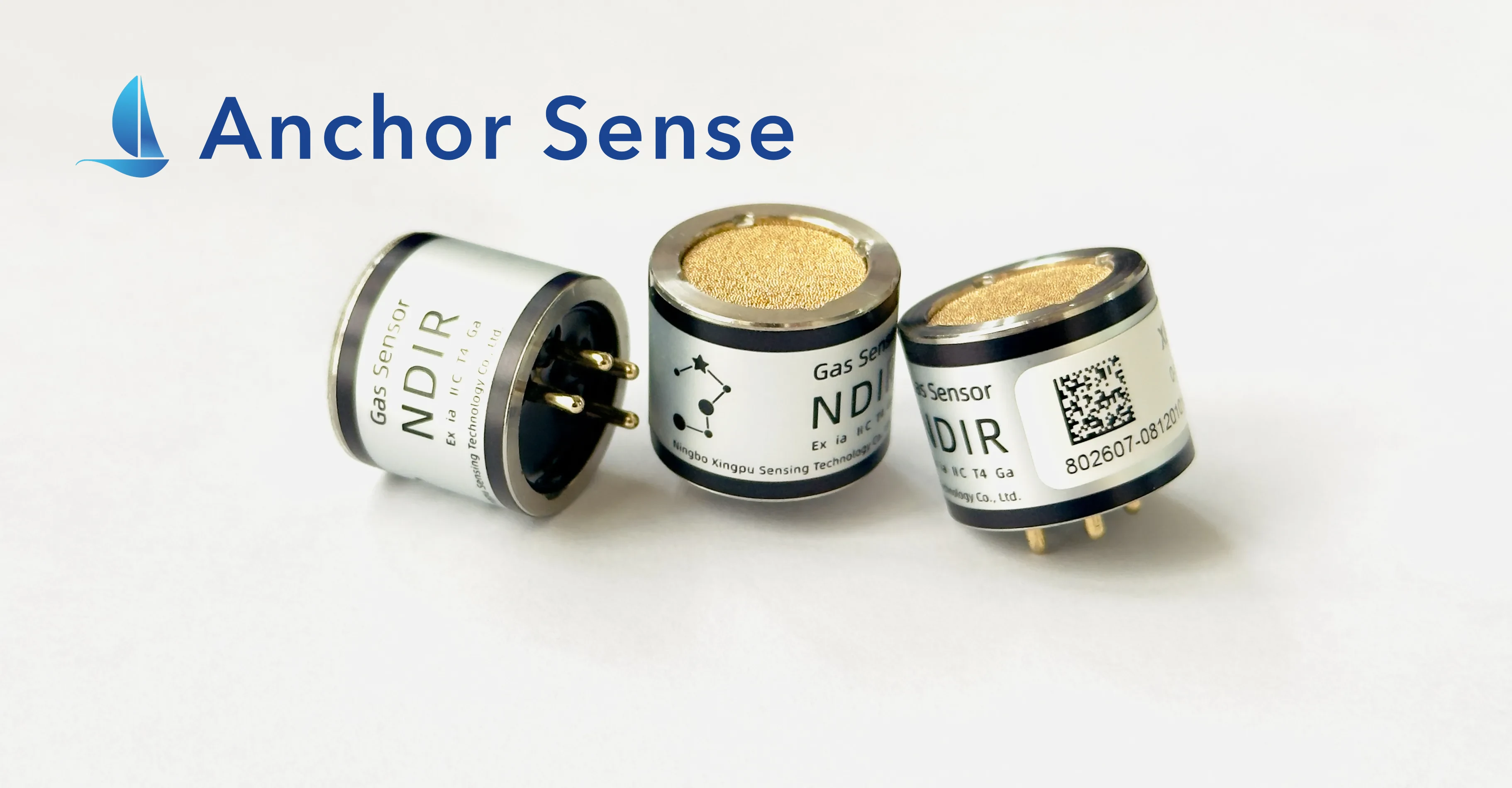
XPSN401A-C00L1 Combustible Gas NDIR Infrared Gas Sensor
Non-Dispersive Infrared (NDIR, low-power dual-wavelength optical path)
Ningbo Xingpu XPSN401A-C00L1, 0 – 100% LFL (Methane/Propane/Isobutane switchable) range, low-power NDIR infrared detection
View Details → XPSN401A-C02L1 Propane NDIR Infrared Gas Sensor
Non-Dispersive Infrared (NDIR, low-power dual-wavelength optical path)
Ningbo Xingpu XPSN401A-C02L1, 0 – 100% LFL range, low-power NDIR infrared detection
View Details →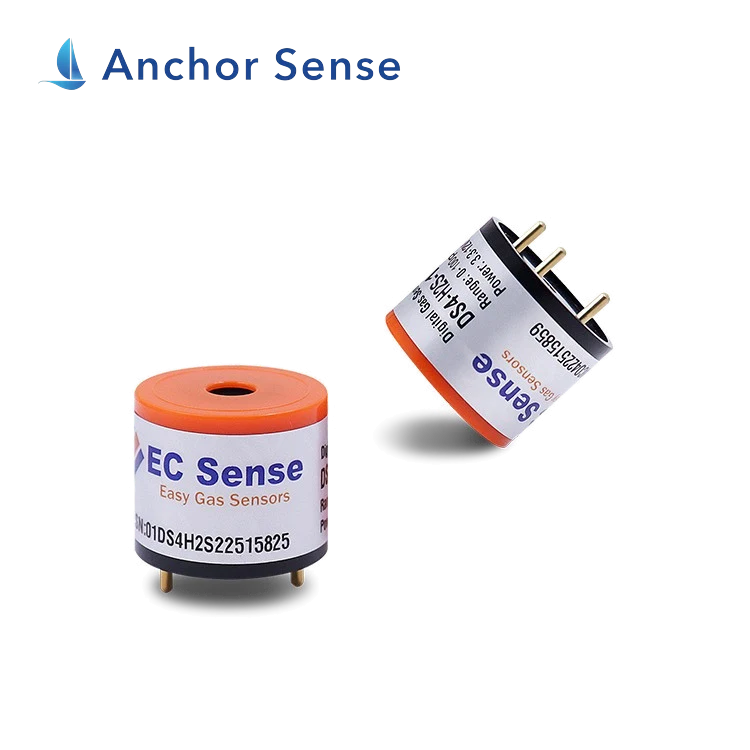
DS4-C2H2-100 Smart Acetylene Gas Sensor
Printed Solid-Polymer Electrochemical (smart digital output)
EC Sense DS4 smart Acetylene sensor, 0 – 100 ppm range, 0.1 ppm resolution, UART digital output, factory-calibrated
View Details →Related Series
Frequently Asked Questions
Why can't an infrared sensor detect hydrogen?
H₂ is a symmetric diatomic molecule with no change in dipole moment, so it produces no infrared absorption band. NDIR and infrared optics simply do not respond to it; hydrogen needs electrochemical, catalytic or thermal-conductivity sensing.
How do catalytic sensors get poisoned?
Siloxanes decompose on the bead and deposit an inert silica layer, while sulphur and halogen compounds alter catalytic activity. Both are irreversible and show up as steadily falling sensitivity — until a real leak reads as clean air.
Can the alarm be set at 100% LEL?
No. 100% LEL is full scale and is also the point at which the atmosphere has reached the lower explosive limit. A first-stage alarm near 10% LEL exists precisely to start ventilation before the concentration reaches the danger zone.
Do refrigerants need combustible gas detection too?
R290, R32 and R600A are flammable refrigerants (class A3 / A2L) and require leak alarms under current regulation. NDIR delivers both low power draw and resistance to poisoning.
Tell Us the Gas, the Atmosphere and the Power Budget
Gas species, whether a %VOL range is required, whether the atmosphere is inerted or oxygen-depleted, mains or battery power, and any preference on sensing principle.
Contact us