
Application / Air & Emission Monitoring
Ambient Air & Stack Emission Gas Monitoring
From flue-gas stacks to fugitive VOC and ambient air grids, the hard part in environmental monitoring is long-term zero stability and low-concentration resolution — not how wide the range is.
- 5 mg/m³ SO₂ exposure limit, PC-TWA (GBZ 2.1)
- 160 µg/m³ Ambient O₃, 1-hour average (Grade I)
- ppm level Resolution for plant-boundary monitoring
- 2–3 years Expected electrochemical lifetime
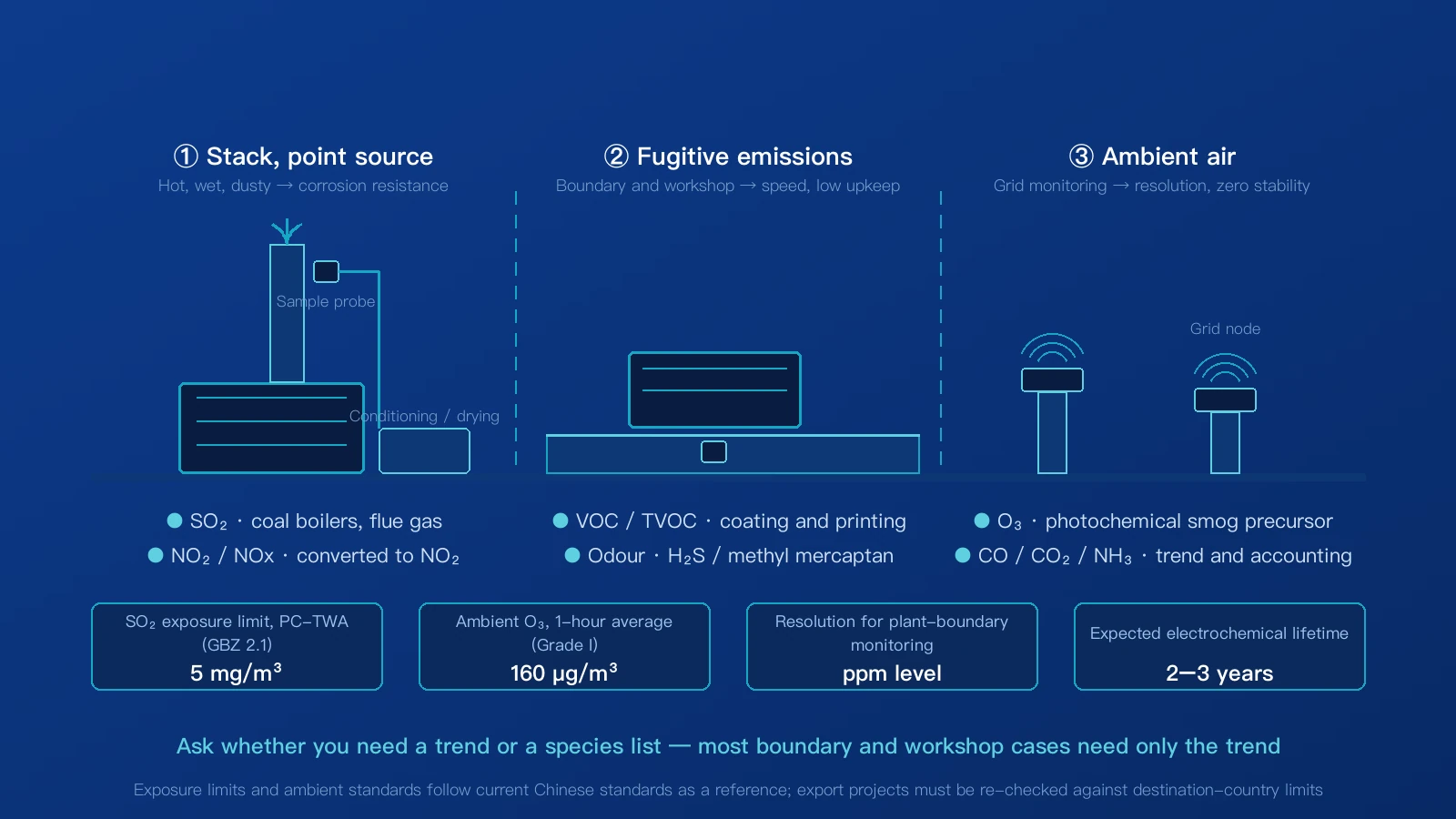
Stacks, Fugitive Emissions, Ambient Air: Three Different Sensor Demands
Stacks run hot, wet and dusty, so the sensor needs upstream conditioning or a long-path sample; corrosion resistance and long-term stability are what decide survival. Fugitive emissions at plant boundaries and in workshops are a point-sensor job for over-limit alarms and before/after comparisons, where speed and low maintenance matter. Ambient grids demand low-concentration resolution and long-term zero stability — a ppm-class sensor is only the entry ticket there.
Two Hidden Costs That Get Overlooked
The first is zero drift: a 3–12 month shift in the zero point is normal for electrochemical toxic-gas sensors, so a project designed on a fit-and-forget basis will see false alarms and missed alarms appearing together within six months. The second is cross-interference — an O₃ channel responds to NO₂, an SO₂ channel to some VOCs, and NDIR CO₂ to humidity. None of these are faults; they are properties of the principle.
- Ask for the cross-sensitivity table, not just the target-gas specification
- Put zero calibration into the maintenance plan, or choose a model with automatic zeroing
- Always condition humid flue gas upstream; don't expect the sensor to cope on its own
VOC Monitoring Doesn't Always Need a PID
If the goal is trend judgement — is anything there, is it rising, is it over the limit — an electrochemical equivalent-VOC sensor costs less than a third of a PID and needs no lamp, no maintenance and very little power. Only when a project needs species identification (benzene, toluene and xylene quantified separately) or ppb-level quantification do a PID and GC become irreplaceable.
Parameters and Ranges for Environmental Monitoring
Covering the usual parameters across stacks, fugitive emissions and ambient air. Particulates are outside our scope and need a separate optical PM module.
| Gas | Typical Range | Recommended Principle | Duty Notes |
|---|---|---|---|
| Sulphur dioxide (SO₂) | 0–20 / 0–100 ppm | Electrochemical | The main acid gas in coal-fired boilers and metallurgical flue gas; PC-TWA exposure limit 5 mg/m³. |
| Nitrogen dioxide (NO₂) / NOx | 0–20 / 0–100 ppm | Electrochemical | Boiler and vehicle emissions; reporting usually converts to NO₂, so confirm the conversion basis before selecting. |
| Ozone (O₃) | 0–5 / 0–100 ppm | Electrochemical | A photochemical smog precursor and a disinfection gas; Grade I ambient standard is 160 µg/m³ as a 1-hour average. |
| Carbon monoxide (CO) | 0–100 ppm | Electrochemical | Both a toxic gas and a direct indicator of combustion efficiency and incomplete burning. |
| VOC / TVOC | 0–10 / 0–200 ppm | Electrochemical equivalent / solid polymer | Fugitive-emission trend monitoring in coating, printing and pharmaceutical shops and at the plant boundary. |
| Carbon dioxide (CO₂) | 0–5000 ppm / 0–100% VOL | NDIR infrared | Greenhouse-gas accounting and combustion-efficiency monitoring; humid flue gas needs conditioning or a humidity-compensated model. |
| Ammonia (NH₃) | 0–100 ppm | Electrochemical | SCR slip and livestock emissions; a problem for both odour and corrosion. |
| Odour factors (H₂S / methyl mercaptan) | 0–5 / 0–500 ppm | Electrochemical | Boundary assessment for wastewater and waste sites — sub-ppm resolution is needed to track what people actually smell. |
Exposure limits and ambient standards follow current Chinese standards as a range and setpoint reference; export projects must be re-checked against destination-country limits.
Models for Environmental Duty
Models used across stack, fugitive and ambient duties — converge in two steps on resolution, then range.
10 gas categories covered
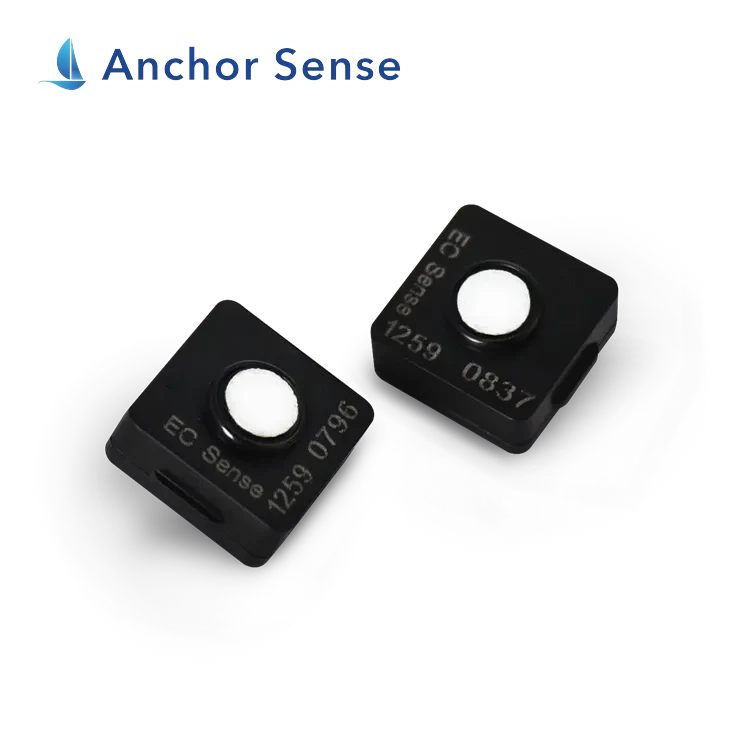
ES1-SO2-100 Sulfur Dioxide Gas Sensor
Amperometric, 3-electrode
ES1 package, 0 – 100 ppm range, Sulfur Dioxide detection
View Details → ES1-NO2-100 Nitrogen Dioxide Gas Sensor
Amperometric, 3-electrode
ES1 package, 0 – 100 ppm range, Nitrogen Dioxide detection
View Details → ES1-O3-100 Ozone Gas Sensor
Amperometric, 3-electrode
ES1 package, 0 – 100 ppm range, Ozone detection
View Details → ES1-AG1-200 All-Gas / VOC Sensor
Solid Polymer Electrochemical (3-electrode amperometric)
Ultra-compact SMD package, 0 – 200 ppm range, all-gas VOC/TVOC-equivalent high-selectivity sensor
View Details →Related Series
Frequently Asked Questions
Will an electrochemical sensor be affected by other gases?
Yes — cross-sensitivity is inherent to the principle. An SO₂ channel responds to some VOCs and an O₃ channel to NO₂. Ask for the cross-sensitivity table and confirm what filtering and compensation the maker has built in.
Does ambient monitoring need ppb resolution?
Only regional background stations and ultra-low-emission assessment need ppb. Plant-boundary and workshop monitoring is well served by ppm-class sensors, and forcing ppb doubles both cost and maintenance burden.
How do you handle NDIR CO₂ in humid flue gas?
Two options: add upstream dehumidification, or choose a model with humidity compensation and a reference channel. Without either, humidity swings show up directly as concentration drift.
Do you supply particulate (PM) sensors?
Our focus is gas sensing; particulates need a separate optical PM module. If a project needs both gaseous parameters and PM, we can quote them together.
Tell Us the Monitoring Tier and the Parameter List
Stack, fugitive or ambient; the parameter list; the required limit of detection; sampling method (in-situ or extractive); and any data-reporting format requirements.
Contact us