
Application / Cold Storage & Refrigeration
Cold Storage & Refrigeration Gas Detection and Sensor Selection
A cold store carries three separate detection jobs: ammonia in the machine room, R744 and oxygen deficiency inside the rooms, and O₂ / CO₂ / ethylene in controlled-atmosphere stores.
- 25 ppm Ammonia TLV-TWA reference
- 10% / 25% LFL Two-stage alarm for flammable refrigerants
- 5000 ppm CO₂ 8-hour exposure limit
- 19.5–23.5% vol Acceptable O₂ band before entry
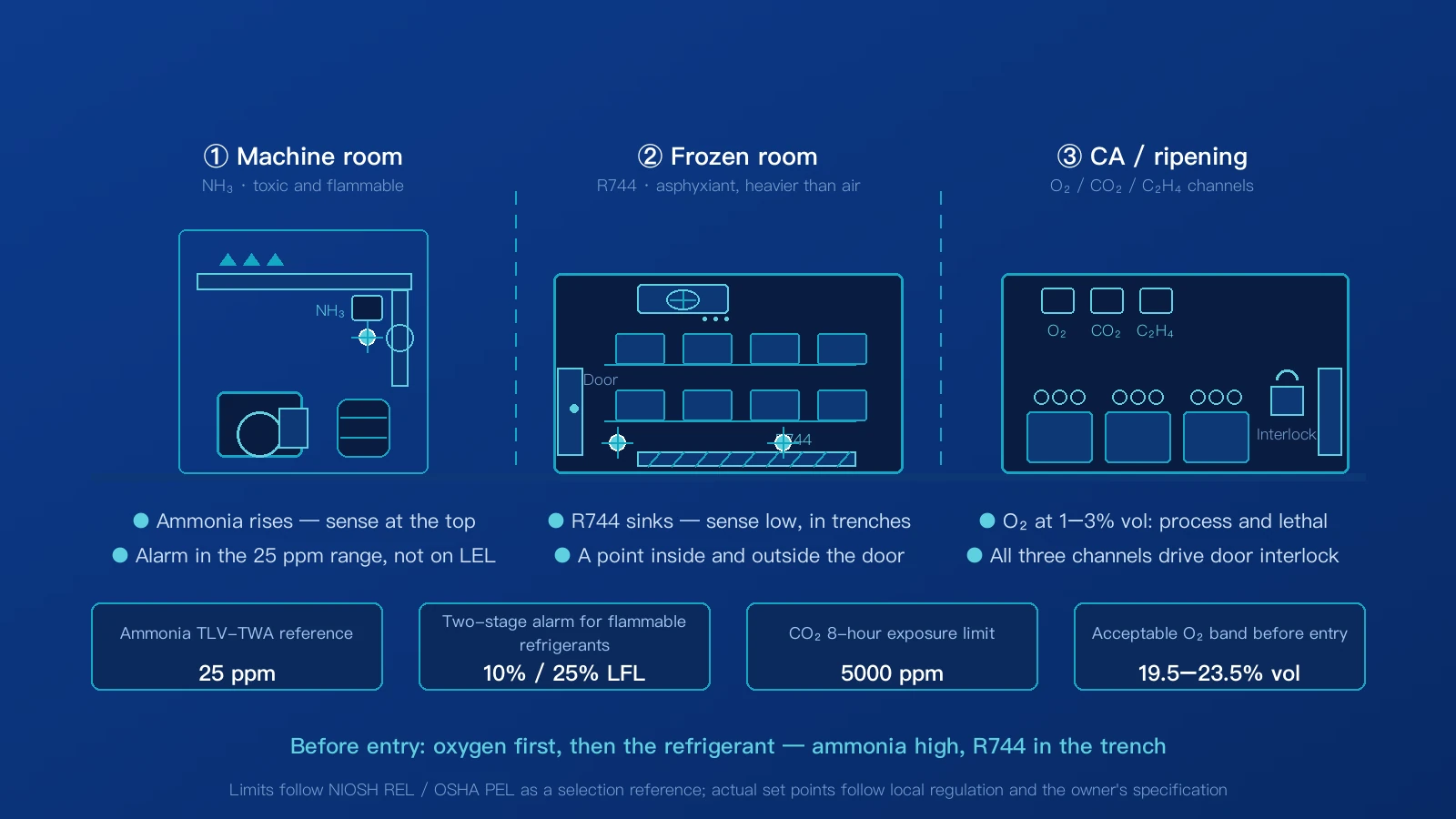
Three Gases, Three Criteria — and Opposite Mounting Heights
Ammonia (R717) in the machine room is toxic and flammable (LEL 15% vol) and lighter than air, so it collects along the ceiling and above pipework. R744 (CO₂) in the rooms and blast tunnels does the opposite: heavier than air, it sinks into trenches, low doorways and under equipment, and a few minutes at high concentration will put a person down. A controlled-atmosphere store is the third case — oxygen is deliberately held at 1–3% vol to slow respiration, which preserves the crop and kills people.
CA and Ripening Rooms: Read O₂, CO₂ and Ethylene Together
A CA store holds O₂ at 1–3% vol and lifts CO₂ to a few % vol; a ripening room introduces ethylene at 10–100 ppm. All three are normal process values and dangerous human ones, so these channels have to drive door interlock and ventilation. The right logic keeps people out — it does not wait until they are already inside.
A2L / A3 Refrigerants: Set-Points and Which Principle Wins
R32 (A2L), R290 (A3), R600a and R454a/b are replacing high-GWP refrigerants, and the price is flammability inside machine rooms and display cases. Alarms follow the common two-stage practice: 10% LFL starts ventilation, 25% LFL shuts off and locks out, with the exact logic settled alongside the project's refrigerant safety design.
Prefer low-power NDIR. It does not depend on oxygen, so the cold room's low temperature and defrost humidity swings will not drag the reading down (a catalytic sensor under-reads in a depleted atmosphere), and low-power parts draw milliamps on average, which suits battery-powered wireless nodes. The price must be stated too: NDIR has no absorption peak for hydrogen or inert gases, so those media need a different principle.
Low Temperature, Condensation and the Maintenance Window
The room picks the hardware, not the other way round: probes cycle between −18 ℃ and high humidity and come back above zero during defrost, so enclosures and sensors must be rated for condensing, sub-zero duty. Calibration gas is unusable in the room — cells normally come out to room temperature to be calibrated — which makes plug-in, single-person replacement matter more to three-year survival than a decimal place of accuracy. Cold stores often cannot be cabled at all, and that is exactly why low-power optical sensors and wireless nodes earn their place here.
Gases to Monitor in Cold Storage
A cold store is never one gas: four refrigerant media along the circuit, plus the oxygen, ethylene and CO that decide whether a person may walk in.
| Gas | Typical Range | Recommended Principle | Duty Notes |
|---|---|---|---|
| Ammonia (R717) | 0–100 / 0–1000 ppm | Electrochemical (smart digital output) | Machine room and pipework; toxic as well as flammable, so set points sit in the 25 ppm range. Lighter than air — sense at the top, never at the same point as R744. |
| Carbon dioxide (R744) | 0–5000 ppm / 0–20% VOL | NDIR infrared | Rooms, blast tunnels and trenches; heavier than air, so sense low. A 0–5% VOL range is also available. The 8-hour exposure limit is 5000 ppm, and high concentrations asphyxiate quickly. |
| Flammable refrigerant (A2L) | 0–100% LFL | Low-power NDIR infrared | The mildly flammable class — R32, R410a·b, R454a·b — replacing R410a in AC and chiller plant; alarm in two stages at 10% / 25% LFL. Each medium needs its own filter and calibration. |
| Flammable refrigerant (A3) | 0–100% LFL | Low-power NDIR infrared | The flammable class — R290 (LEL 2.1% vol) and R600a (1.8% vol) — common in self-contained and commercial display cases, so points go in the plant room and inside the cabinet. |
| Oxygen (O₂) | 0–25% vol | Electrochemical | The 1–3% vol held in a CA store is a process value and a lethal one. Entry band is 19.5–23.5% vol, and oxygen is the first test in the sequence. |
| Ethylene (C₂H₄) | 0–20 / 0–500 ppm | Electrochemical (smart digital output) | Ripening-room process control and residue checks; the 0.01 ppm resolution range serves residue and leak judgement. |
| Carbon monoxide (CO) | 0–100 / 0–1000 ppm | Electrochemical | LPG and diesel forklifts inside, loading docks and standby generators; the ≤35 ppm entry limit matches confined-space practice. |
Limits follow NIOSH REL / OSHA PEL and common confined-space practice, as a selection reference only. This page does not replace the refrigerating system's safety design; set points and interlock logic must follow the refrigerant type, charge size, machine-room form and local regulation.
Recommended Models for Cold Storage
Covers ammonia, R744 and A2L/A3 flammable refrigerants, plus the oxygen and ethylene channels of CA and ripening rooms. Fixed units and battery nodes can share one model, collapsing spares and calibration into a single set.
11 gas categories covered
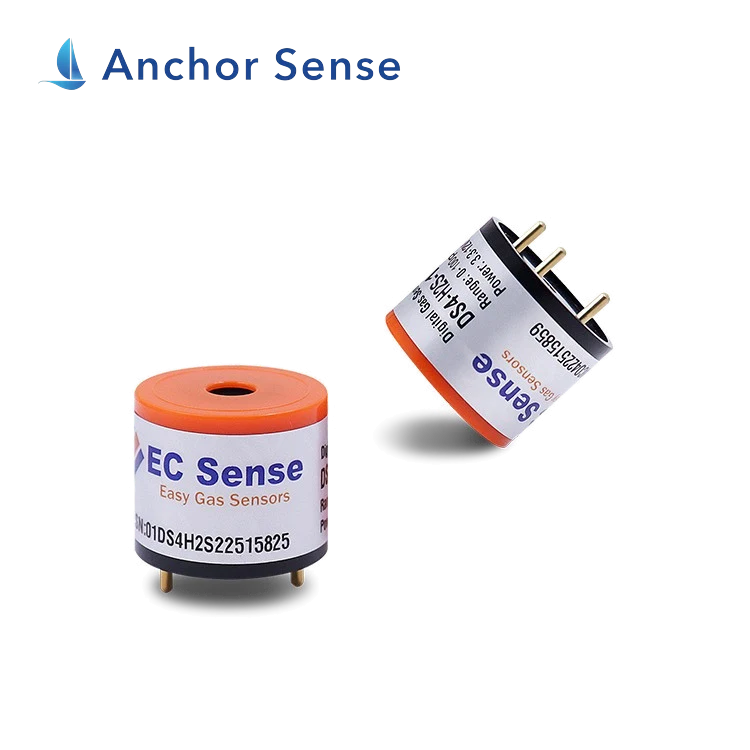
DS4-NH3-100 Smart Ammonia Gas Sensor
Printed Solid-Polymer Electrochemical (smart digital output)
EC Sense DS4 smart Ammonia sensor, 0 – 100 ppm range, 0.5 ppm resolution, UART digital output, factory-calibrated
View Details →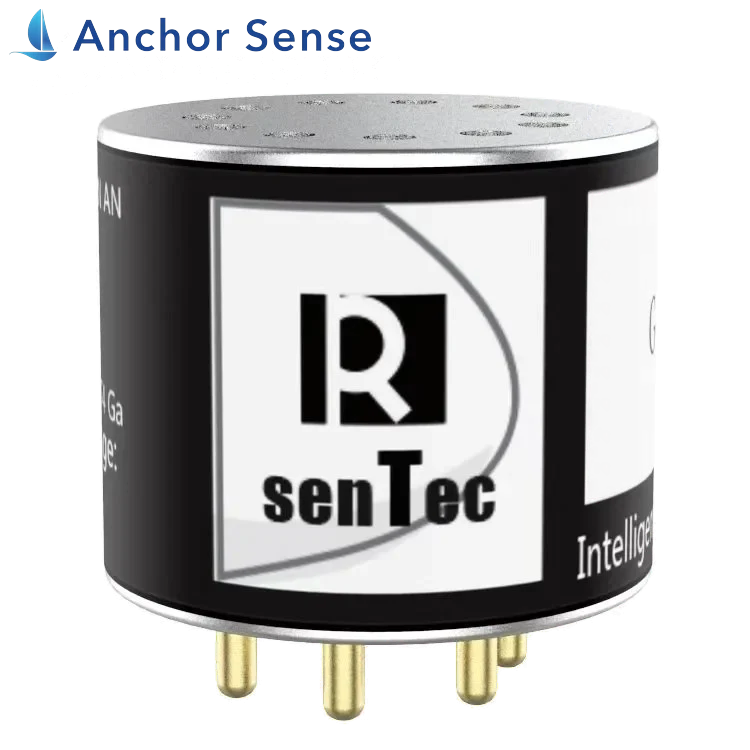
G4446 Carbon Dioxide NDIR Infrared Gas Sensor
Non-Dispersive Infrared (NDIR, dual-wavelength optical path)
Shanghai Yixin G4446, 0 – 20% VOL range, dual-wavelength NDIR detection
View Details →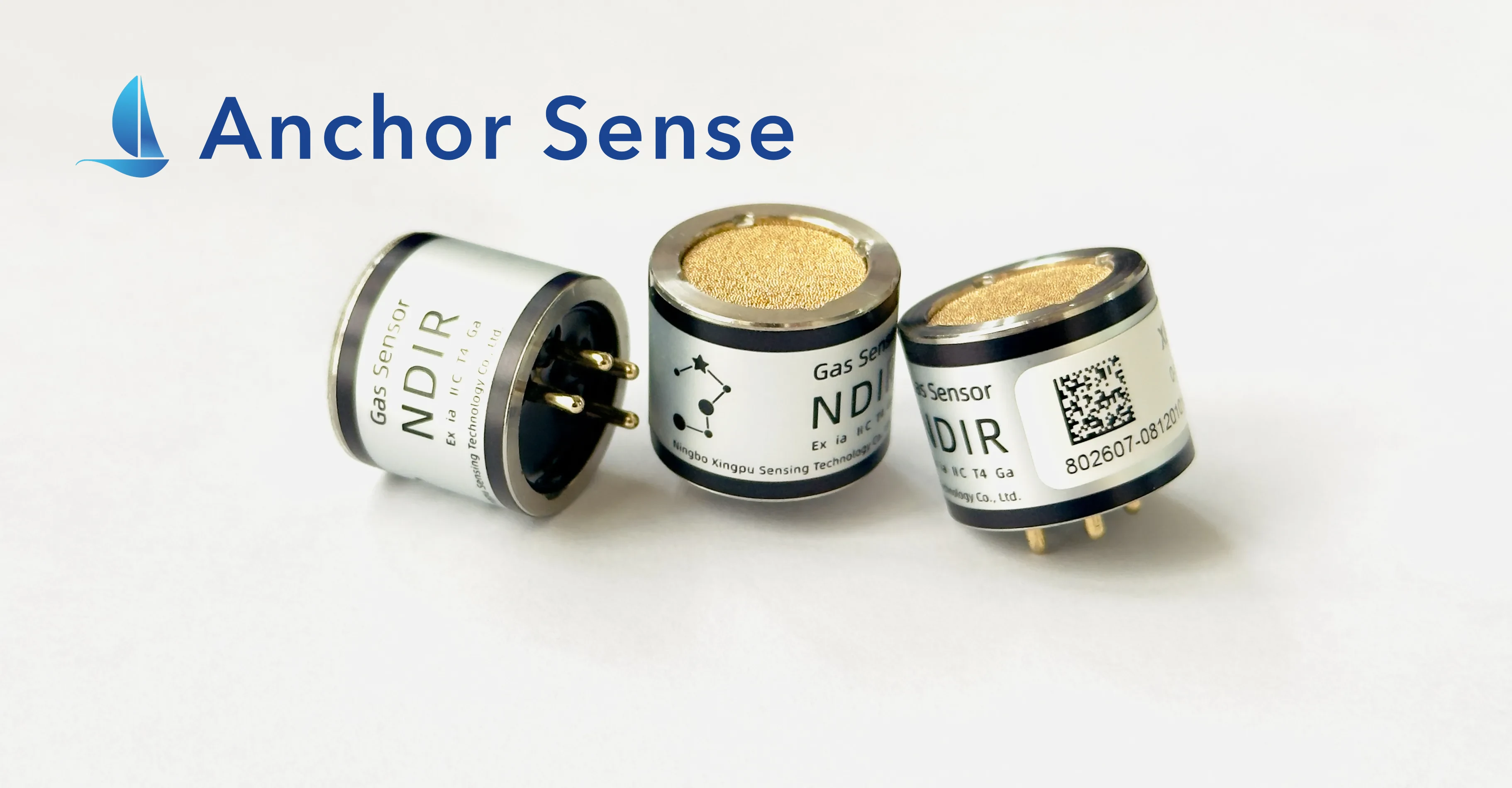
XPSN40A-R04L3 R290 NDIR Infrared Gas Sensor
Non-Dispersive Infrared (NDIR, low-power dual-wavelength optical path)
Ningbo Xingpu XPSN40A-R04L3, 0 – 100% LFL range, low-power NDIR infrared detection
View Details → DS4-C2H4-20 Smart Ethylene Gas Sensor
Printed Solid-Polymer Electrochemical (smart digital output)
EC Sense DS4 smart Ethylene sensor, 0 – 20 ppm range, 0.01 ppm resolution, UART digital output, factory-calibrated
View Details →Related Series
Frequently Asked Questions
Why ppm-level electrochemical for ammonia instead of catalytic?
Because ammonia's LEL is 15% vol. A 10% LEL alarm waits for 1.5% vol — 15,000 ppm — while the occupational limit sits in the 25 ppm range, three orders of magnitude lower. By the time the alarm fires, exposure is far past the limit. Ammonia here is first and foremost a toxic gas, so the set point follows toxicity and the sensor is ppm-level electrochemical.
Why is R744 leakage dangerous, and where does the sensor go?
R744 is colourless and odourless, heavier than air, and pools in trenches, low doorways and under equipment. At high concentration it asphyxiates within minutes with no warning cue at all. Sense low and in the trenches, with a point inside and outside the door; start alarms in the region of the 5000 ppm eight-hour limit and settle the exact value and ventilation interlock with the project design.
The low O₂ in a CA store is intentional — why alarm on it?
Because 1–3% vol preserves the crop and is lethal hypoxia for a person, who loses judgement within tens of seconds and will not walk out unaided. Oxygen sensing in a CA store therefore has to drive the door interlock: the right behaviour is a door that will not open, not an alarm after it did.
Can catalytic sensors be used for flammable refrigerants?
They work, but they are a poor fit in a cold store: catalytic sensors depend on oxygen and under-read when it is depleted, silicone vapour and sulphur-bearing media poison the bead irreversibly, and low temperature plus condensation hurts long-term stability. Low-power NDIR is oxygen-independent and draws milliamps, which suits battery nodes — unless the medium itself has no infrared absorption peak.
Tell Us the Room Type and the Refrigerant
Room type and scale (chilled, frozen, blast, CA, ripening), refrigerant type and charge, point counts in the machine room and inside the rooms, whether door and ventilation interlock is required, and power and communications.
Contact us